Collection is welcome by appointment as usual until 12th April and from 16th April. PLEASE BE ADVISED THAT I CAN'T DESPATCH ANY SHIPPING ORDERS UNTIL 20th APRIL. I'm responding to email as usual. Dismiss
Some of my stock sells within days, others could take years before making their way to a new home. There are a wide range of preferences within the world of people interested in old window glass (including stained glass), but I find that the items that I put up for sale that sell the quickest are often the smallest. This can be spare parts for stained glass artists and leaded lights makers, top light windows that can be installed to let light into a room or used for decoration, and those which are “above door” size and round windows.
Pieces I acquired in earlier years eventually come to the attention of someone who is looking for them. Part of the value of my business is having a large range of glass for customers to explore online, so that they don’t need to choose only from what an individual happens to be selling on third party platforms like Facebook Marketplace or eBay.
Waiting patiently for its new home
I thought it might be of interest to highlight one of those long shelf life items that I’ve had for years, and (after a browse through the stock on my website) have settled on this set of four mostly purple leaded windows which I rescued from the stairwell of a house in Chingford, June 2021…
It’s clear to me that the reason this set hasn’t sold yet is because it’s large, and a set of four that depends on the pattern connecting. As you can imagine the cost to ship internationally would be considerable. Talking of ships, this took just over one year to set sale…
Stock that sells more quickly are often smaller windows that could be used for multiple purposes – as decoration on a wall or as an internal partition, as well as replacing external windows. An example of a window that’s sold quickly recently is this geometric pattern, with four leaded lights in a wooden frame. It sold, to a customer in the USA, within a week of my listing it on the website. It’s small, colourful and compact, and it is flexible in that it could be placed vertically or horizontally. I photograph glass in both orientations whenever this makes sense.
Another feature that’s great for shipping is that because the frame is divided into multiple parts, a board can rest on the surface with greater support, thus reducing the possibility of it touching the glass if under pressure.
Old glass in short supply
Other glass I stock, which I often don’t keep for too long, is replacement parts used by stained glass artists, leaded light makers and glaziers. This could be roundels, figure rolled panes and all sorts of other glass! If you’re trying to match glass when repairing a window with cracks, then finding the right replacement glass can be tricky when the glass stopped being made decades ago. Or if you’re a creative making a new window from scratch, then you might not want to use the same bland range of machine-made products from China, often referred to as “hobby glass”.
Sometimes I have quite a selection of a particular glass in stock (such as Small flemish); whereas other (rarer) glass that I put on the website usually sells immediately. An example of this is cut glass glory stars – at the time of writing I only have eight available. People often ask if I have more and if I’m feeling witty I might say, sorry I’ve checked down the back of the sofa, nothing there!
A1716b. Small flemishA1732b. Blue cut glass glory star
Pricing to sell and to make a profit
I can’t ignore the fact that, at times, it is glass that I have priced higher that can take longer to find a customer. Pieces such as these are beautiful art works which deserve to be valued highly, in addition to me needing to make a viable income. So I accept that they need to wait in my possession until the kind of person who wants to invest in stained glass art discovers them (while always thinking of ways to try and get the word out).
RH027. Hand painted man and woodland sceneA1618c. Hand painted birds in a leaded stained glass window
Portability and packagability
It makes sense, theoretically at least, that an item is more likely to sell quickly if it is available to the widest range of people. The difficulty with this, with the product I’m selling, is that it doesn’t always make sense to make glass available for delivery anywhere in the world. If a window is small and can be packaged efficiently and shipped safely, then I am happy to sell it to anyone, wherever they are – with a delivery charge on the listing or working out a price on an individual basis.
For larger pieces of glass, particularly those which are frameless, it often isn’t worth the risk of offering to ship, as packaging them safely would involve a custom made wooden crate with a pallet base. That type of packaging is often costlier than the value of the glass, if the customer only wants one piece. Most people aren’t willing to pay that unless buying in multiples. It makes more sense to wait for a customer who can come and collect, or (if within Great Britain) who wants to pay for me to make a personal delivery.
… that it doesn’t matter how long pieces take to sell. That’s because I have the luxury of being able to change the view from my window if I get bored.
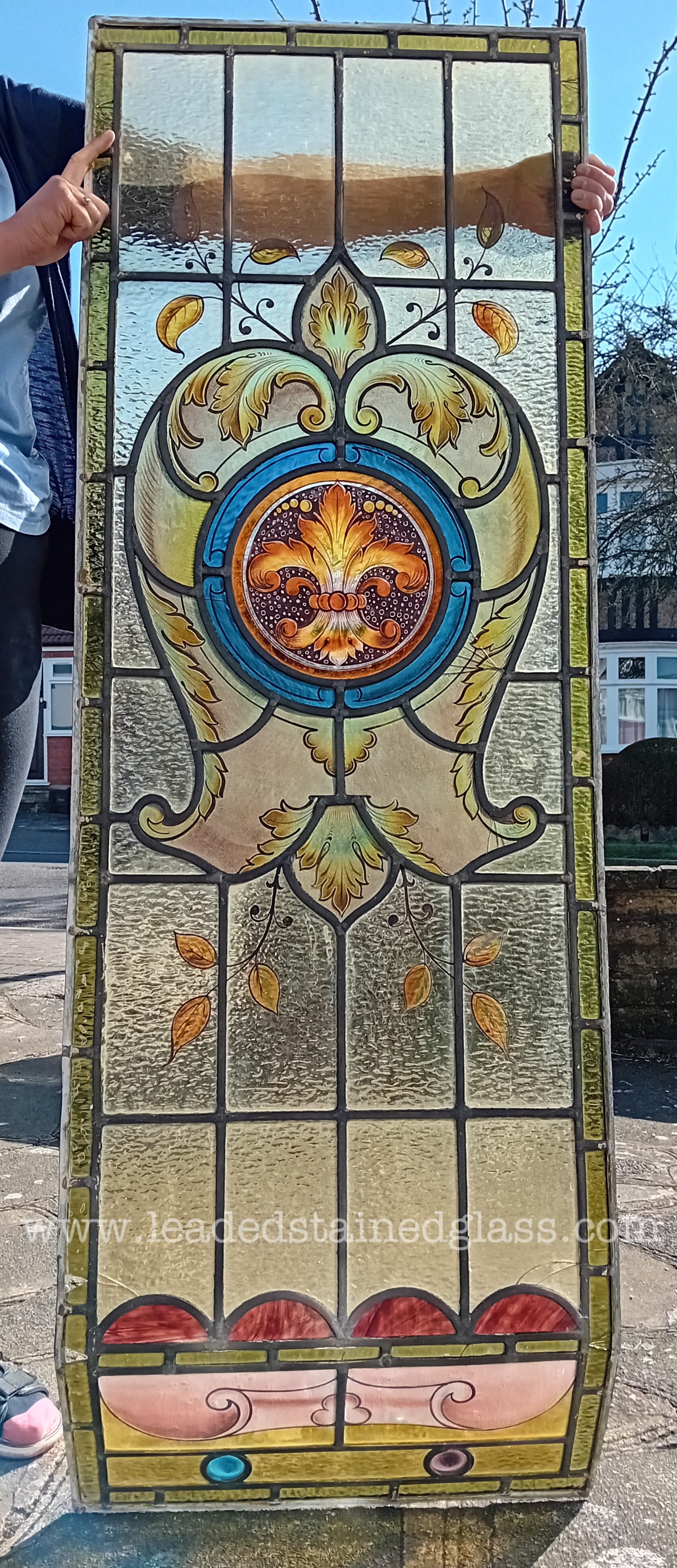
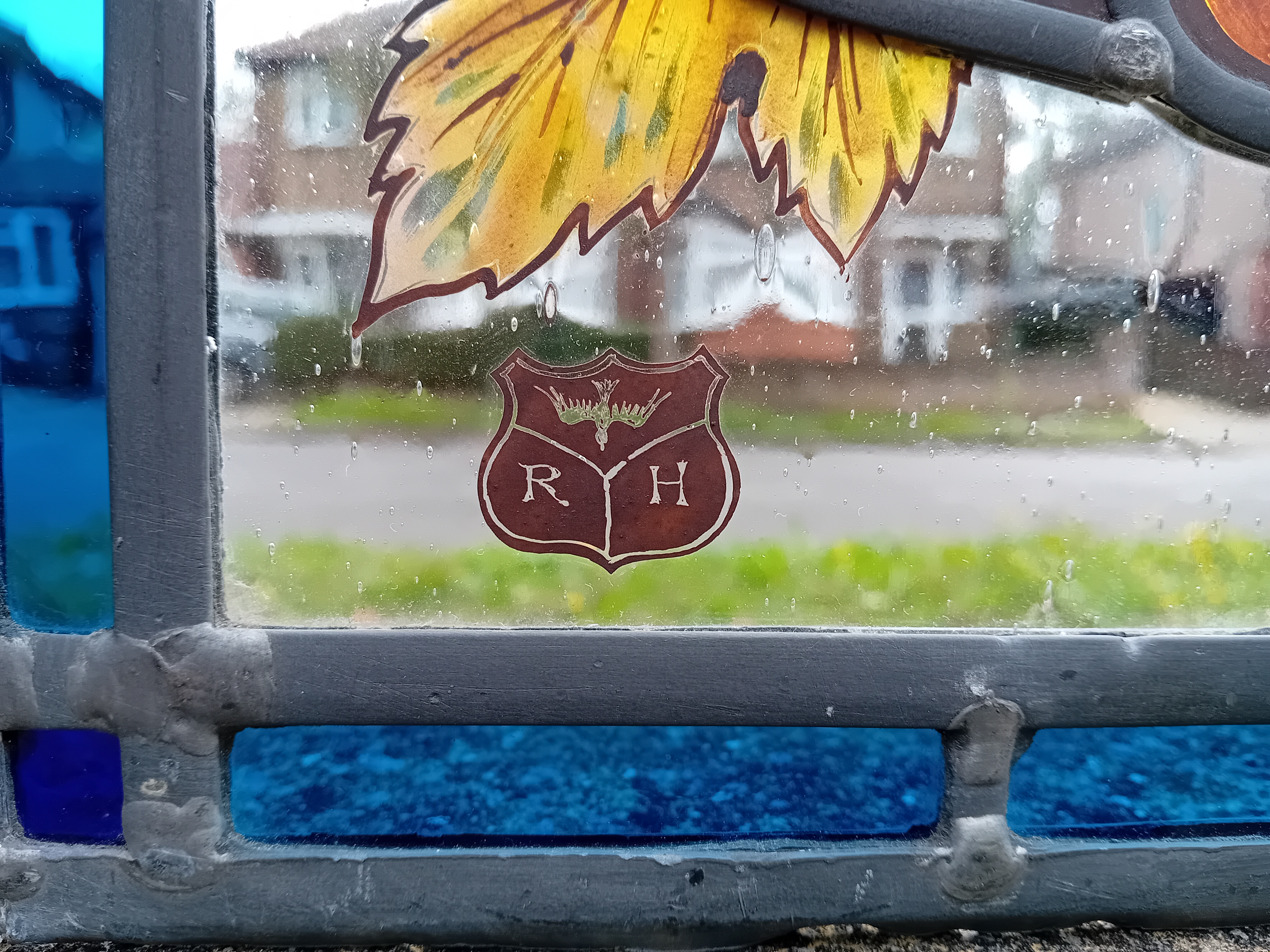
Several of the panes were cracked. As I’m a specialist salvage dealer, finding spare parts may not always be an issue, but it certainly is for any panes which are hand painted. This one had two cracked painted panes…
The cost of commissioning a stained glass artist to make replacement parts, and fit, would likely be more than I paid for the entire leaded light. I know several talented stained glass artists who would do an amazing job but they still wouldn’t be able to produce an exact match, given that the paint and glass originally used are no longer available.
Something I can’t usually demonstrate when selling glass exclusively online is the robustness of the lead structure. The larger the leaded light, the more this should be a concern, just as much as the condition of the glass. In this example, however, it is easy to show that the leaded light had a significant kink along one of the horizontal lead lines…
Unfortunately just snapping the lower section off wouldn’t be a remedy, as the outer border would still need repair to complete the pattern.
The decisions
Sometimes I have to make the difficult decision whether to:
1) Sell in current condition
2) Have someone restore it
3) Dismantle to sell the parts
When I acquire a piece like this I may spend a few days pondering what to do. I could sell in its current “rustic” condition, a look which some people intentionally seek. But that could take a long time, given how large it is, and my London storage space is at a premium!
Restoration, transport and storage
If repairing, I would have to lug it to the restorer and back, after that I may still have to store long-term, and the shipping costs associated with a piece this size will make it harder to sell whatever condition it’s in. Now that I have years of experience, it’s very unlikely I will invest in a repair unless I’ve sold something similar for a worthwhile profit. Even if I want it restored, finding the right person with availability is another time consuming factor.
Ease of taking apart
Part of my decision to dismantle will be informed by how easy I think the process would be. My assessment is made by feeling the lead structure. From experience I can tell if a leaded light has been poorly constructed, even if it contains amazing glass. It could be that it was made with inferior cement or the cement has dried out so much that the bond between lead and glass is weak, or non existent.
If I conclude that the leaded light is more valuable in parts, I still have to consider how much money I will lose if I damage X number of parts, even with my experience of dismantling. In this example, I bought the leaded light with the full intention that I would dismantle, knowing the risks and likely profit margin. Therefore I bid for it accordingly.
Time
Probably the most important consideration is how much of my time will the dismantling process take? The more complex the lead pattern, the more time it will take, so is the glass worth it? Also, the time commitment to clear up the mess is not something to be underestimated…
The parts
Another time commitment to factor in will be photographing the fragments. With a piece like this I know all the parts can be utilised. Obviously the centre piece was the fleur-de-lis roundel…
… no doubt someone will use it as a new centre piece. Not only does the fragment contain a detailed heraldic pattern but the blue hand painted border is just as impressive, in my opinion anyway. The most alluring aspect, though, will be the convenient shipping price for this bold, but now relatively small, fragment.
Some of the floral parts could still be used to form part of a joining symmetrical pattern…
…or the entire set could be reused within some sort of collage?
Old handspun roundels sell like hot cakes! I predict this pair will have sold within 7 days of listing.
These scrolls could work in all sorts of ways.
There’s certainly enough border glass here for a new small window – why buy modern “hobby glass”, probably made in China, when there’s so much interesting old glass lying around Britain?
Who uses the glass?
I have a varied customer base. While many people buy whole windows from me, I have an increasing following of people who work with old glass in a variety of ways. I suspect the people buying the above parts will be “arty” people. The parts will be used in projects for new leaded lights rather than replacements. Therefore the pattern can be made to fit around the size of these old parts. Many of my customers are abroad so this is an ideal opportunity for people to buy unique pieces.
I also sell to people doing repairs who need an exact match. They could be glaziers or confident “DIYers”. The above parts wouldn’t be aimed at that market group. I do dismantle leaded lights which don’t contain any hand painted glass. I might refer to this as “architectural window glass”. This is an example of one I dismantled because it had so many “decent sized” small flemish background panes, as well as interesting borders…
Again, this large leaded light had structural issues as well as damaged panes.This process could take at least one hour!
My post small flemish big suprise, documents another set of large leaded lights which I deconstructed.
Conclusions
If you’ve got this far and are still fuming that I caused such carnage, I must say that I did list the hand painted leaded light for one week beforehand in my windows for restoration category. And on Instagram I gave notice that it had only 24 hours to live, but no one paid the ransom!
It is a hard decision to make but I always know that nothing will go to waste!
I will eventually take several buckets of lead to a scrap metal dealer – beer money!
At the time of publishing this blog post, all the above glass was listed for sale on my website in the following categories:
I feel privileged to have had the opportunity to acquire a large amount of Robert’s art. Either as complete leaded lights…
… or fragments which were perhaps first stage drafts, surplus or separated parts…
Robert was educated in Birmingham (UK) and studied at the School of Art (this is according to his book – I’m presuming it was Birmingham School of Art). He became an apprentice at the John Hardman Studios (established 1838) and later one of its directors.
Robert pictured in a 1980 National Exhibition Centre promotional article for the Glassex 80 Exhibit.
The following text is from a Birmingham Evening Mail 2005 article which was promoting his book, which he had recently written.
‘…Hickling took eight years to complete the 5ft by 4ft glass panels which tell the tale of Little Missi Two Shoes, based on his nine-year-old grand-daughter Katie…
Her adventures in a land of witches, goblins and creepy crawlies are brought to life in vivid colours and imagery in a style normally reserved for religious scenes.’
It is fascinating to read about Hickling’s inspiration for his book (which was illustrated with his glass): “This book just came out of the blue and my grand-daughter was my inspiration. When I saw her walk in her first pair of shoes I said ‘look at her Little Missi Two Shoes’.”
His words really resonate in relation to some of his other pieces that I can’t believe I have: “Glass has its own magic. Most people look at stained glass in churches but what I’ve tried to do is bring nature into it so you can see birds and animals.”
I learned from the article that Hickling had been working for 43 years when he retired, but was encouraged by his wife to continue creating in his retirement.
Although the article mentions him working locally, I’ve found tributes to him on Facebook where people reference his work as far wide as New Zealand. For anyone who is not aware, AMGP, stands for Associate Master Glass Painter.
At the time of publishing this blog post I have not finished listing all the hand painted fragments I’ve acquired from Robert’s amazing stash…
Richard regularly describes himself as a one-man business – often when having a bit of a moan about having too much to do, and really wanting to focus on using the knowledge he’s built of the industry to buy nice stock. It is true that his business is run by him on his own, without any employees. He is – to use a technical term – a sole trader.
The pair featured in the above photo are for sale as A1568b (adverts enable this blog post to be free!)
I’m reminded though, at this point of the proverb “Behind every great man is a great woman”. I’m being somewhat facetious here, as I worry that quote could come across as sexist, suggesting that the work that men are known for is always based on hidden work done by women. This might have been true in the past, and has truth today on a macro level, but on an individual level I don’t want to diminish the huge amount of work Richard has put into building up this very unique business. Having said that… I mentioned a few of the ways I help out in my previous guest post, A librarian on a glass trip and Richard has now got me working on another task, trying to improve the reach of his website through Search Engine Optimisation (with better use of Instagram coming up too). While I do have my own job to do, as an academic librarian (documented to an extent on my own Researcher Librarian blog), I am interested in this topic, and as a business librarian it is theoretically within my territory.
Deciding to try some marketing
The impetus to work on marketing came from the awareness that Richard’s website has lots of people coming to it (unsurprising, considering all the pretty pictures of stained glass!), but not as many of the the views turn into sales as we would like.
While the business started as what could be described as a side hustle, it has for many years been Richard’s job, and a key source of our family income. There are probably things Richard (we) can consider doing to improve the rate of views leading to people pressing purchase at the checkout, but it is understandable really that people think and look for quite a while before investing in glass for their home. It’s also understandable that people want to check out the authenticity of a person who offers to ship stained glass all over the world.
Increasing the number of website visitors
A potential solution, to the fact that not enough of the people browsing are actually buying, is to expand the number of potential customers browsing the website. Even if there are lots of people already browsing there are surely more who don’t know of the business already, or don’t even know yet that an old stained glass window would be the perfect addition to their home – even if used as wall art rather than as a functional window!
Lauren’s privacy screen, which Richard shipped to her in North Carolina – it simply hangs behind the existing window – more available coded R820.
I am quite active on LinkedIn these days, as I’m doing a lot professionally, and a post written by someone who works in Search Engine Optimisation (SEO) came up in my feed. I liked the post, and she followed me, and I followed back (usually how things work on LinkedIn!). This now means that I’ve had lots of SEO posts appearing in my LinkedIn feed, and I’m regularly discovering ideas for how to increase the potential for Richard’s website coming up when people search on Google. What I’ve been doing is a work in progress, and I’m not an expert at it yet, but I (we) thought it might be interesting to share.
through email that he sends out to different groups of people (he has four identified customer groups: home owners wanting salvage, home owners wanting bespoke, trade buyers and people working in the stained glass industry needing spare pieces of old glass which is not made anymore)
He gets me to read through all his email mailouts and blog posts before sending them out, checking for typos and tone (I don’t always agree with his tone – he can get a bit rude for my liking at times…!). Anyway, I have an interest in the blog posts, so this is where I decided to start with my ‘marketing campaign’ (when I write marketing campaign, I’m very aware of the various marketing professionals, researchers and students who I know – if any of them read this at any point, I know there is a lot more to the whole thing than the pulling together of ideas and trying things out that I am doing!).
Why the focus on blog posts?
Blog posts have value beyond being an opportunity to reflect and document and self-congratulate(!) on what you’ve been doing. They are a method of building a relationship with your potential customers without directly marketing products…
But as we’ve got your attention, isn’t this sunray, A1371f, delightful!
…they allow people to get to know you (and your family business). People might find a blog post on a topic they’re researching which isn’t directly related to your business (such as his QuickBooks post) and then become aware of your business, using or recommending it at a later date. Richard tells me these ideas come from my LinkedIn SEO contact, Emma Dow – I’ve been reading lots of things aloud to him, but forget where it comes from!
There’s such a lot of work that goes into the blog posts (some of them at least) and, while they get lots of views when they are first published, this is less common a few months down the line. I think there’s valuable content – that could help people in their glass purchase decision making – which gets lost as time passes and they disappear from the homepage menu. An example is Steptoe – the reality of architectural salvage dealing in modern London (it surprises me that it’s well over two years ago that this post was published – I remember it well, including doing quite a bit of research into how to attribute the Creative Commons copyright for several images).
Identifying and integrating keywords for Search Engine Optimisation
My reading about SEO – and my experience as a librarian from the search side (teaching people to search for academic literature and secondary data is a major part of my job) – tell me that the keywords you allocate to a blog post or webpage are vital for new people to be able to find your content. There are tools that can be used to identify the words that people coming to a webpage via a search engine are using, and possibly even words that people are using that don’t get to your website (maybe that go to competitors…). These tools can help with thinking about what words to include in your posts. This kind of software has a cost though, so is probably used more by marketing professionals who can invest in a subscription when working on campaigns for multiple businesses (if anyone does have a recommendation of a free keyword analysis tool, then please do let us know!).
I have done what I can with Google Analytics, which is included with Richard’s WordPress website subscription (WordPress is the platform where his website is hosted). To be honest, while the information available is very interesting, and gets me wanting to learn to use Google Analytics properly, it didn’t bring up any big surprises!
Following SEO people on LinkedIn, and seeing lots of posts on the topic, means that I am constantly developing in my learning, and not long before publishing this post I discovered a really useful post which includes advice on how to use Google Search Console. You can use this tool to identify potentially relevant words that people use when searching which don’t include your website high up on the first page of Google results.
Richard’s website is 20th in the list of results when people search for ‘architectural salvage stained glass’ – far beyond how far most people will scroll! (But the above search was done over a week ago; I now note he is appearing 7th.)
This has been very enlightening, and even made Richard, when I showed him, tempted to change the strapline on his homepage (which is currently “British Leaded Lights and Stained Glass…”) on the spot. I managed to stop him before he did this – we need to explore the data more before making big decisions! Richard encourages me to say here what words we have concluded on, but this really is a work in progress.
When I write posts on my own blog, I always include tags – keywords that the blog post is about – and which can be included as a link to refer people to other blog posts on a similar topic. I also add Alt Text (a description) to images – this is mainly to ensure that my images are accessible for people using screen readers (for example people who are blind or partially sighted), but I have also read that use of Alt Text affects the order search engines might put you in on a results page.
An image from my last guest blog post, with the Alt Text displayed in the HTML code
Record keeping to keep track of the effects of SEO
Tags and Alt Text are two things I was aware Richard hadn’t been doing, so I have been on the case – sometime with the help of our daughter. There are currently over 70 posts published on the blog, so there’s a lot to do, but we have made a good start. I’ve treated it as a proper project, and have an Excel spreadsheet to keep track of what changes have been made to each blog post, and when (librarians love a good spreadsheet!). I then hope to be able to refer back to this in a few weeks (months?) time to see whether the search engine optimisation efforts have had any success – I know that you do have to be patient in waiting for these things to work!)
Richard assures me that he will take on some of these things himself when writing blog posts in the future. I’ve done it for this post myself though!
I wrote earlier that I’m constantly discovering new things to do to improve SEO. Another one, which I should really have cottoned on to sooner, is including headings in your blog post, actually formatting these as headings, and perhaps even including them as a linked list of contents at the beginning of your post. I think this advice also came initially from the LinkedIn post I referred to earlier. Doing this should help readers to get a clear idea of what the post is about, and give search tools accessible information to better trawl and promote your website. Richard’s previous blog posts only have headings in bold, rather than formatted as a heading – if they have headings at all. So I have lots of work to go back and make changes, including all the record keeping that I described earlier. The first blog posts that I included headings in – the latest post on my own blog – resulted in my highest ever number of impressions on LinkedIn.
Richard is working on an Instagram strategy – something I was originally going to write about now, but which we have decided to leave to another post.
There is a frustrating oddity on the website in that the search box only searches stock, not all pages, meaning the content on the blog is hidden, and not easily searchable.
We don’t have an obvious link to view all blog posts – they’re just displayed on the left hand side of pages when using a computer, and hidden away at the bottom of the page on a mobile device.
Educating people to use the website product filters which again only appear on the left hand side of pages if using a computer.
There are other things that should be considered when writing blog posts, some of which Richard and/or I are already doing – use of images, bulleted lists, and others which we’re not doing enough of, such as thinking about the placement of your post’s keywords within the post, and ending each post with a Call to Action (CTA).
Finally, I have a feeling there are pages with stock on, or business information, which would benefit from have links to relevant blog posts, which might not have been published at the time.
Call to action
To finish with one of these plans for the future, here is a Call to Action: if you’re a regular reader of this blog, please would you let us know (via a comment, or an email), of a previous post that you’ve found useful or interesting and that you perhaps think we should highlight more. If you’ve found this post by chance, via a search engine, please let us know as well – it would be fascinating to learn how you found us!
Alice doesn’t know I’ve written the following: she wrote the above so all I have to do is press “publish”. The bottom line is no matter how sophisticated my marketing strategies are, there’s no way I can operate my business without Alice’s unpaid support. She really does have a life of her own and a professional job! But she drops whatever she’s doing to help me. Other examples are IT trouble-shooting, the endless stream of window holding for photography (all the windows you see in pairs are held by her!) and being a devoted mother to my children while I obsess over my business. THANK YOU ALICE!
When Richard has been on his many trips around the country over the years, collecting and delivering, and meeting with fellow stained glass enthusiasts, he has occasionally been asked whether his wife ever comes with him on these trips (or at least that’s what he tells me – maybe to keep me involved!). There is good reason why I haven’t taken up this opportunity:
We have two children who, while they’re getting older, do need a parent to cook them meals and keep them company
Though I support Richard in his business, especially with holding windows for photography, and creating Excel formulas, I do have my own job to be getting on with, as an academic librarian (and emerging researcher – which is the theme of my own blog)
Guarding treasure in Grantham which will eventually appear in the Victorian category.
But at long last, in early April this year, I have been with my husband on a business trip, one which took us from London to Edinburgh and back again, with many places in between. He’s taken one or other of our children on some of these trips in the past, but only for a night or two – I had a whole five nights away! We are very lucky to have wonderful parents to look after our children while we took this ‘Busman’s holiday’.
My ‘work’ during the trip
I wasn’t only along for the ride – Richard did find me things to do:
I did some deliveries (from van to door!) and took some part in carrying the windows we collected to our van.
I sent all the text messages letting people know that we’d be with them in half an hour – a very important task this, as they’ve usually been given a wider time slot, and occasionally we’ve been delayed due to traffic.
I researched alternative accommodation when our planned hotel fell through (a broken boiler!) Richard spends a huge amount of time planning all the logistics in advance of a trip. My usual research is using the likes of Bloomberg, and academic journal databases, but I can switch to hotels.com on request!
I offered my opinion on whether we (and it does feel like we) should buy certain pieces, sometimes during a ‘board meeting’ over dinner! Though as a business librarian, I must make clear this is a joke – there is no board of directors as the business is a small concern that doesn’t require them…
I guarded purchased stock (with book in hand), from the wind and from interested passers by, while Richard rearranged glass in the van. Working out where to safely put all the treasure acquired – which will gradually be added to the website in the coming weeks and months – was a regular issue throughout the trip.
I got to visit some interesting businesses, and unique and beautiful houses. I regularly get to see what some of Richard’s customers do with the glass they purchase from him, in the images he posts on his Customer reuse ideas page, but have only now had the opportunity to be shown round a customer’s home – one of the aspects of these trips that I always enjoy hearing about. [Note – I distracted myself for a good ten minutes looking again through the reuse ideas page, when I had intended to just get the URL to provide a link!]
Delivery in Birmingham
What I’ve learnt from the trip
Travelling around the country in a van is very tiring, both for the driver (Richard) and for the person along for the ride (me). We did manage a bit of exploring in the cities and towns we stayed in (and even had a night staying and socialising with family – we brought a stained glass suncatcher as a gift, as well as a bottle of wine!), but on several evenings were too tired for tourism beyond a meal.
Where we did venture out to our surroundings, we spotted glass in all sorts of places – in a fascinating grade 2 listed pub in Liverpool, and in the Adelphi hotel in the same city. Our history and research interests led to us reading up about the background of this hotel. My librarian tendency to read critically and look at multiple sources meant that I got the more positive perspective from the hotel’s website, and some more shocking details from Wikipedia (I won’t go off on more of a tangent by listing my further research on this topic!)
There are many skilled people who work with stained glass. Seeing some locations where the ‘magic’ happens was fascinating.
There’s only so much you can fit in a medium-sized van. And quite a bit of this will need to be stored in near vicinity to me, until it can be photographed and eventually sold. As Richard has been unpacking the van and putting glass in temporary locations before photography and proper storage, I’ve enjoyed surprises seeing them displayed around the house. But I must not get too attached!
The Vines (The Big House, Lime Street, Liverpool – Grade 2 listed
The Grand Lounge of the Adelphi hotel, Liverpool – the ceiling consists of Victorian rolled glass panes!
We have stacks of small framed windows (toplights) waiting to be listed in the trade category.
Most people prioritise putting washing in the machine when they get back from a holiday…
This scenic pattern is from a set of doubleglazed units which will soon be listed in the scenic category.
Merging a glass trip with a holiday
While this was a business trip for Richard, it was definitely also a holiday for us both. It may not surprise you to learn that my husband finds it hard to stop working at times, and it is the same for me. Turning off from work is very hard when you’re running your own business from home, and it’s almost as challenging as a subject librarian who’s the library liaison for thousands of people (to say nothing of my current research obsession!). Therefore days off work when at home are never fully days off – work is always on your mind. For me, being on this trip, getting more involved in sourcing salvaged window glass, I was able to properly take a break from my usual preoccupations. Though I admit that I have referred to my job multiple times in this post!
When not eating or socialising, as described above, I got lots of opportunity to read (I collect books at the rate Richard collects windows, though am less keen to let go of them than Richard is willing to part from the glass – necessary when running a business!). For a librarian, I’m not very strong at ‘weeding’ (aka withdrawing books from) my collection, and have many shelves of books waiting to be read.
We listened, while driving, to multiple podcasts. So the time on the road didn’t feel wasted, and was enjoyable. While our listening was more of the comedy and true crime variety, I’ll take this moment to highlight the time Richard was on a podcast, True Tales from Old Houses, talking about his glass business…
We even played a game, despite being away without our children! Proper evidence that my husband did take me on a holiday, not just a business trip!
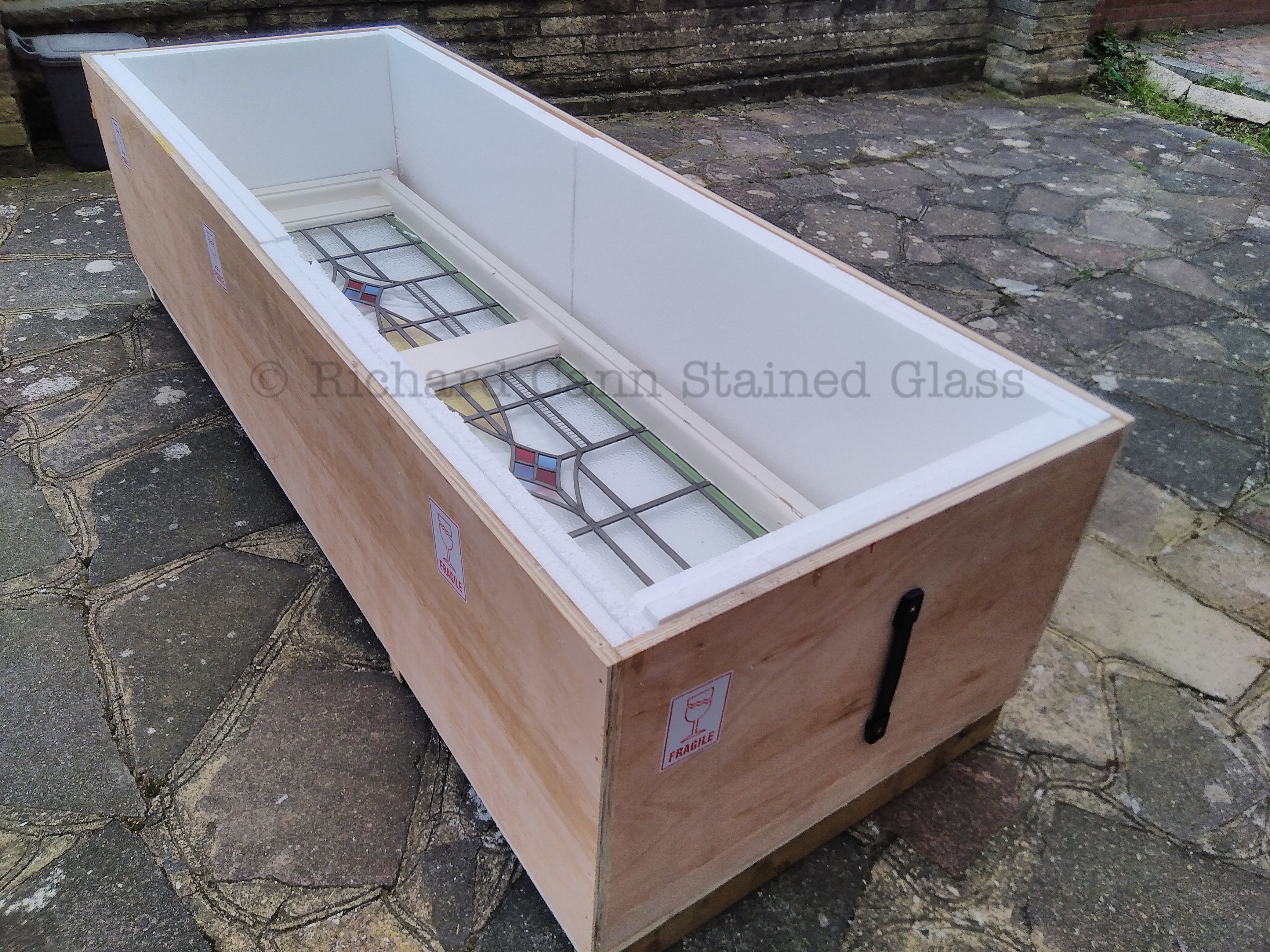
Here’s a crate that safely arrived this week in Edmonton, AB (Canada).
Sometimes when I’ve finished packaging an order for shipment I think to myself, this packaging is as much a work of art as the stained glass! But here’s some of the treasure Natasha received:
Natasha says “The windows have arrived and are in perfect shape! I think the deliveryman thinks I’m nuts! I’m just as excited about the crate with all the activities I can do with it! Thank you so much …You made this little Canadian girl very happy!
The tracking for this is a typical example of how long delivery to North America takes via air freight. It doesn’t seem to make any difference how large the package is.
From receiving a customer’s payment it takes me a few days to package before the crate will be collected.
Combined shipping Please always ask me for a combined shipping price, regardless of what total the cart shows. This is because the cart:
is not capable of computing a discount for combined shipping
has a quirk where if you select a listing that offers shipping but also select another which does not, it will still process your order, not making it clear that one is not eligible for shipping!
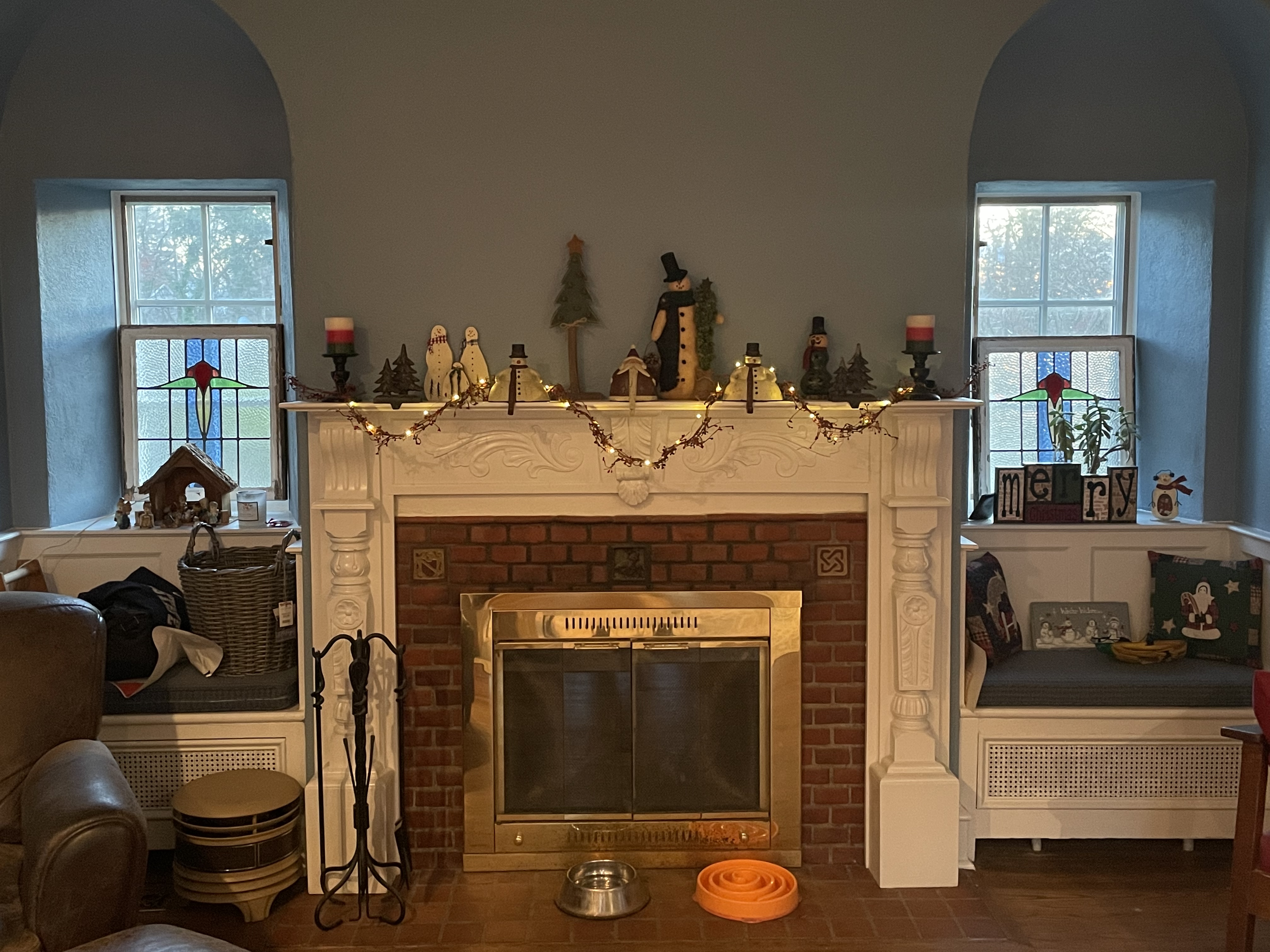
Here’s what Kathy did with a pair she received from me yesterday. I sent them to her home in Philadelphia. These were only despatched with DHL on 28th November*
Kathy says “Wow!! I can’t believe they are here already! This set fits even more perfectly in our space than I had pictured. Wish I had gotten home before the sun went behind the trees but I couldn’t wait to send these pics. My husband and I can’t stop smiling at them.” Actually, I think Kathy took these photos at a perfect time as she has caught the “glow” of the room which complements the surrounding seasonal decorations.
I rescued these from a house in Gateshead, Tyne and Wear (North East England)…
There are only three remaining for sale which are larger…
A1226e
Click here to view the remaining A1226 windows for sale.
*For international orders I can’t guarantee a five-day arrival from despatch(!) and sometimes my packaging process takes up to three days.
I admit maintaining traditional windows and other wooden features on even a modest 1920s three-bed semi is hard work.
2014
Ideally a new layer of paint should be applied every 5 – 10 years.
2022
But I think it’s worth it.
Each time I’ve done this some passer-by feels it necessary to make the useful suggestion that they would do it just using a ladder. I’m of the old-fashioned opinion that if a job’s not going to be done properly then there’s no point doing it at all!
The front exterior of my house is available for film/photo shoot location hire. It is now very difficult to find ordinary 1920s properties like this, complete with original features which have been maintained. I suggest it could be used for any period from 1920s – 1990s. Please contact me for further information.
When on tour collecting treasure, I sometimes work from my vehicle measuring and cleaning the stock. This saves me time so I don’t have to process when I return to headquarters. My 25 year old Toyota Estima import is just as reliable today as it was when I bought it in 2015. It’s true that “they don’t make ’em like they used to”. The seat configurations of this MPV allows me to use it as a workbench, fill the whole car with windows or accommodate children.
Incidentally the window featured in the above photo is for sale as a pair:
An explanation of the reasons old British window glass can sell very quickly as soon as it's put on the leaded stained glass website, while some takes a long time.
Hand painted stained glass acquired from the work of Associate Master Glass Painter Robert Roy Hickling, now for sale. Including details of Hickling's professional work.
A discussion of the differences between hand painted stained glass and coloured glass, with my perspective based on my experience buying and selling reclaimed British window glass.
The discovery of a round stained glass window featuring a painted glass owl. Exploring the provenance, asking for help to find out more about the glazier artist, and offering the window for sale.