Posted on Leave a comment

Difficult decisions

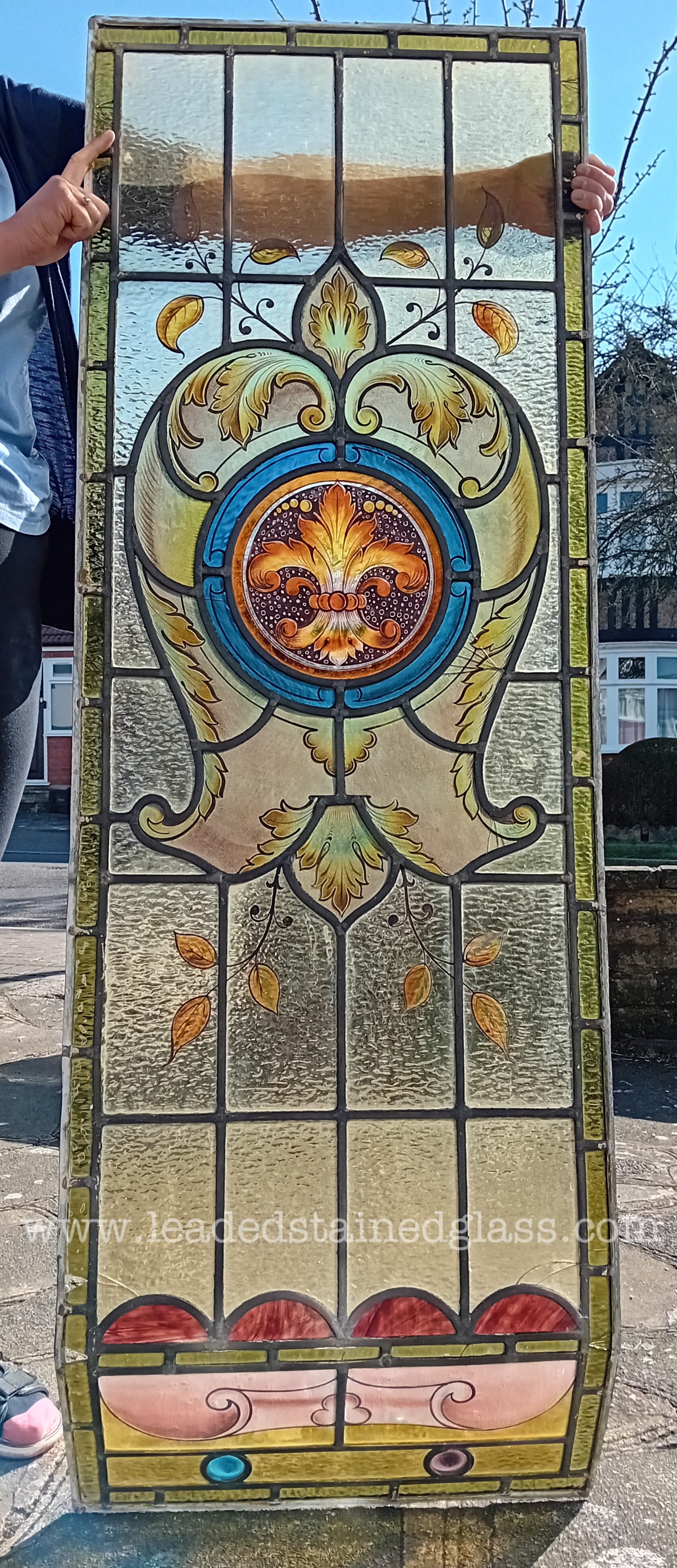
A hand painted leaded stained glass window panel with a kink at the bottom. It features a fleur-de-lis roundel in the middle.

I recently dismantled this stained glass leaded light. I know it looked fantastic but this post aims to explain why I would do such a thing.

In this post I will discuss:

What was wrong with it?

Several of the panes were cracked. As I’m a specialist salvage dealer, finding spare parts may not always be an issue, but it certainly is for any panes which are hand painted. This one had two cracked painted panes…

A hand painted leaded stained glass window panel with a fleur-de-lis roundel in the middle and three damaged panes.


The cost of commissioning a stained glass artist to make replacement parts, and fit, would likely be more than I paid for the entire leaded light. I know several talented stained glass artists who would do an amazing job but they still wouldn’t be able to produce an exact match, given that the paint and glass originally used are no longer available.

Something I can’t usually demonstrate when selling glass exclusively online is the robustness of the lead structure. The larger the leaded light, the more this should be a concern, just as much as the condition of the glass. In this example, however, it is easy to show that the leaded light had a significant kink along one of the horizontal lead lines…

Unfortunately just snapping the lower section off wouldn’t be a remedy, as the outer border would still need repair to complete the pattern.

The decisions

Sometimes I have to make the difficult decision whether to:

1) Sell in current condition

2) Have someone restore it

3) Dismantle to sell the parts

When I acquire a piece like this I may spend a few days pondering what to do. I could sell in its current “rustic” condition, a look which some people intentionally seek. But that could take a long time, given how large it is, and my London storage space is at a premium!

Restoration, transport and storage

If repairing, I would have to lug it to the restorer and back, after that I may still have to store long-term, and the shipping costs associated with a piece this size will make it harder to sell whatever condition it’s in. Now that I have years of experience, it’s very unlikely I will invest in a repair unless I’ve sold something similar for a worthwhile profit. Even if I want it restored, finding the right person with availability is another time consuming factor.

Ease of taking apart

Part of my decision to dismantle will be informed by how easy I think the process would be. My assessment is made by feeling the lead structure. From experience I can tell if a leaded light has been poorly constructed, even if it contains amazing glass. It could be that it was made with inferior cement or the cement has dried out so much that the bond between lead and glass is weak, or non existent.

If I conclude that the leaded light is more valuable in parts, I still have to consider how much money I will lose if I damage X number of parts, even with my experience of dismantling. In this example, I bought the leaded light with the full intention that I would dismantle, knowing the risks and likely profit margin. Therefore I bid for it accordingly.

Time

Probably the most important consideration is how much of my time will the dismantling process take? The more complex the lead pattern, the more time it will take, so is the glass worth it? Also, the time commitment to clear up the mess is not something to be underestimated…

A partly deconstructed leaded stained glass window lying on a table surrounded by all its cement debris and separated panes.

The parts

Another time commitment to factor in will be photographing the fragments. With a piece like this I know all the parts can be utilised. Obviously the centre piece was the fleur-de-lis roundel…

A fleur-de-lis hand painted leaded stained glass window roundel. It has a blue border with scroll-like ended curved lines.

… no doubt someone will use it as a new centre piece. Not only does the fragment contain a detailed heraldic pattern but the blue hand painted border is just as impressive, in my opinion anyway. The most alluring aspect, though, will be the convenient shipping price for this bold, but now relatively small, fragment.

Some of the floral parts could still be used to form part of a joining symmetrical pattern…

…or the entire set could be reused within some sort of collage?

Old handspun roundels sell like hot cakes! I predict this pair will have sold within 7 days of listing.

One blue and one purple hand spun window roundel.

These scrolls could work in all sorts of ways.

Hand painted scrolls on two stained glass window panes.

There’s certainly enough border glass here for a new small window – why buy modern “hobby glass”, probably made in China, when there’s so much interesting old glass lying around Britain?

Green border sized stained glass window panes.

Who uses the glass?

I have a varied customer base. While many people buy whole windows from me, I have an increasing following of people who work with old glass in a variety of ways. I suspect the people buying the above parts will be “arty” people. The parts will be used in projects for new leaded lights rather than replacements. Therefore the pattern can be made to fit around the size of these old parts. Many of my customers are abroad so this is an ideal opportunity for people to buy unique pieces.

I also sell to people doing repairs who need an exact match. They could be glaziers or confident “DIYers”. The above parts wouldn’t be aimed at that market group. I do dismantle leaded lights which don’t contain any hand painted glass. I might refer to this as “architectural window glass”. This is an example of one I dismantled because it had so many “decent sized” small flemish background panes, as well as interesting borders…

My post small flemish big suprise, documents another set of large leaded lights which I deconstructed.

Conclusions

If you’ve got this far and are still fuming that I caused such carnage, I must say that I did list the hand painted leaded light for one week beforehand in my windows for restoration category. And on Instagram I gave notice that it had only 24 hours to live, but no one paid the ransom!

It is a hard decision to make but I always know that nothing will go to waste!

I will eventually take several buckets of lead to a scrap metal dealer – beer money!

At the time of publishing this blog post, all the above glass was listed for sale on my website in the following categories:
Posted on 1 Comment

My 2023 USA visit and kryptonite

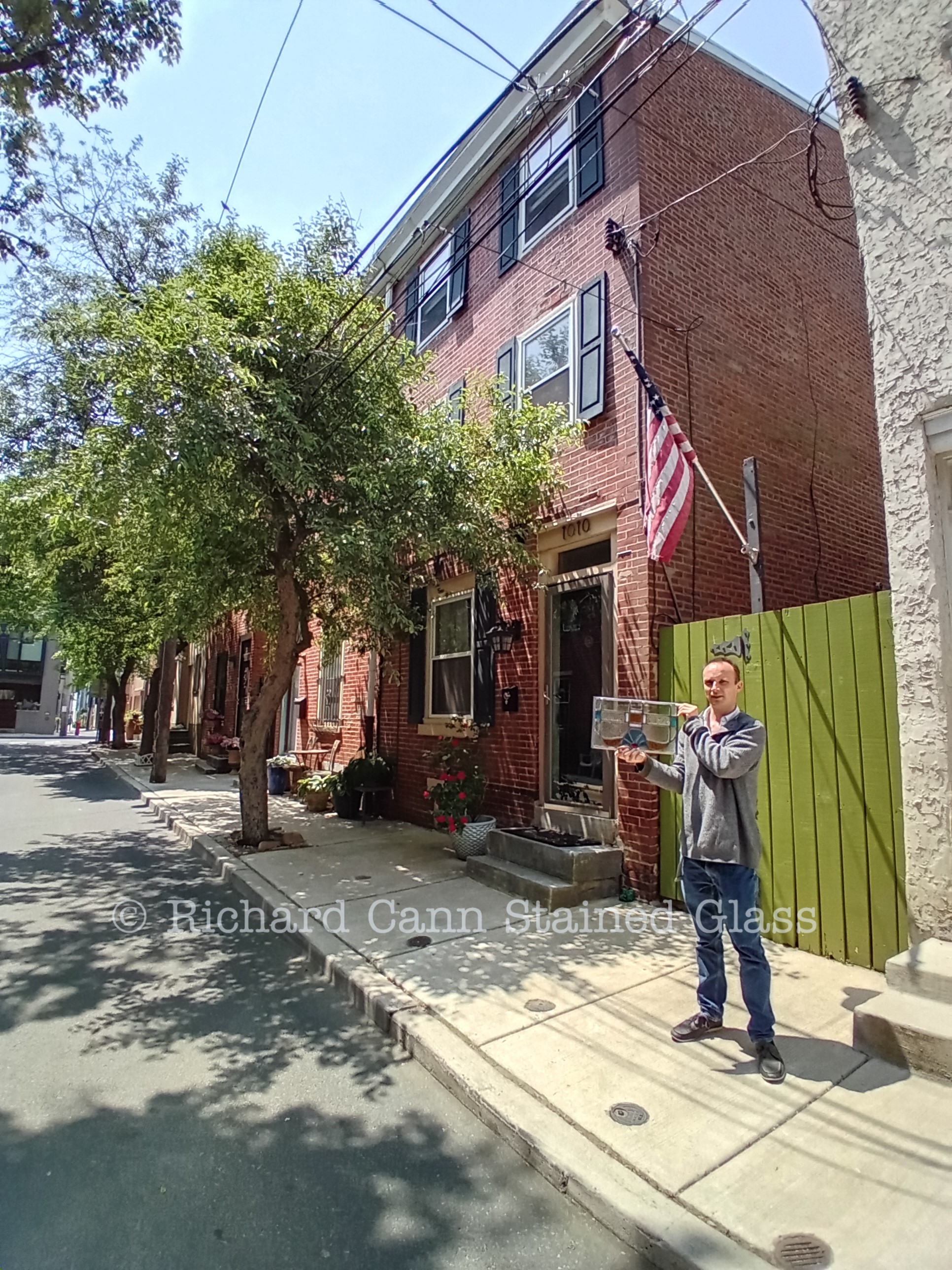
A three storey building at the end of a terrace, with pavement, trees and road. A man (Richard) holding up a stained glass window in front

Regular visitors to my website may have noticed that for part of May I was unable to ship any orders. That’s because I was in Pennsylvania and New Jersey. I had a brilliant time meeting existing customers and showing samples to
potential customers.

This New Jersey antique store seemed familiar. That’s because it was formerly a Woolworths – In England we used to have that store chain as well!

Two Brits in America

Not only does the British accent tend to open doors (or windows!) but when you walk into a USA antique store with my product, people tend to be very surprised – usually in a nice way. I always say to Americans that British stained glass is not better, but it is distinctive*

I needed an assistant. The successful applicant, my mum, was appointed on the basis that she was happy to do what I want and follow me anywhere: box ticked! We arrived in Philadelphia, where we spent the first four days.

Independence Hall – the original capital of the USA, where the Declaration of Independence and the Constitution were signed.

We’re not really into tourist attractions. I appreciated Independence Hall** but what we really enjoyed in Philadelphia was visiting an architectural salvage dealer at a church. He invited us to see all the items of value his crew were removing. This is my idea of sightseeing!

It was in North West Philadelphia, in one of the “less desirable” neighbourhoods. It’s my opinion that this is where the good stuff can be found. Once an area has been “upgraded” or “gentrified” there’s less treasure about and of what remains the new owners may be less willing to part with.

It was an ordinary church for that area and dates to 1927 by the architect George Lovett. I wasn’t particularly impressed with the stained glass as whole windows but there were fragments that stood out. Increasingly with church glass I’m finding it’s more practical to sell as spare parts if one has the time and space to dismantle***. The salvager had already removed several intricately carved stone pieces such as those highlighted below:

What interested me is the large size of the building given it was a relatively ordinary church. Just like in England, these old churches are gutted to be turned into condominiums.

Everything is bigger in America!
My beautiful assistant!

From another church, the dealer gave me this clump of glass which was also from an ecclesiastical window. In his store he had baskets full of these. I guess paper weights are just one ornamental reuse idea. It’s incredible how something this thick could be used in a window; it reminds me of kryptonite from the Superman movies. He gave us each a piece which we treasure as mementos of the trip – you can’t get this from a museum gift shop!

Kryptonite!

Our accommodation was in Northern Liberties (NoLibs as the locals call it) which was easy access to Old City. I don’t often drink Coke but felt a desire as I was in the USA. However gentrification meant it wasn’t on the menu at the local cafe so I had to make do with a lavender lemonade!

We rented a rowhouse. These charming little buildings are what defines Philadelphia for me. There’s a bedroom on each level. These date to the 1800s – a Philly resident told me those with dormer windows are early 1800s.

A rowhouse on our street.

Shop buildings in Philadelphia, and I imagine many other areas of the USA, have the ceilings decorated with pressed tin. While old British buildings might have ornate plaster moulds it’s not feasible to fill the whole ceiling with that method. I liked how these ceilings haven’t been repainted in a long time. It contributed to the rustic character the cafes wanted to convey.

Many Americans tell me they admire Britain because we have “history” and “old buildings”. How old is “old”? The majority of old houses that most British people live in are late Victorian – 1930s. Philadelphia is a relatively small city but I can’t think of anywhere in London where there are so many clusters of 19th century housing that middle-income people live in. Yes we have castles and stately homes but they are either owned by luxury hotel chains or the aristocracy or have been donated to the National Trust. No doubt you can find quaint British Bed and Breakfast accommodation which claim to date hundreds of years but most likely those buildings have been significantly developed in order to be habitable. If you change the head of a broom and later its handle, is it the same broom?

After Philadelphia we drove to Sullivan County in north eastern Pennsylvania which has a small village on a mountain top called Eagles Mere. We were fortunate to stay in one of its houses built by my Great Great Grandfather. It opened as an Inn in 1890.

In the colour photo my mother sits in the same place as her Great Grandmother from the older photo.

For me there’s a lot of history in the USA! Eagles Mere has gone through several changes. In the first half of the 19th century its lake was used to make glass, due to the sand it produced. The glass factory at Eagles Mere failed partly because it was cheaper for the USA to import glass from England. While in Britain we don’t make new glass for export any more (we don’t make much!) I like that, in a way, I am carrying on the tradition of exporting British made window glass.

I won’t go into detail about where else we stayed in Pennsylvania but it was very nice. We made some planned stops to antique vendors and some impromptu. You can’t miss some of these places on main routes which have huge signs saying “ANTIQUES”. Just like in England, people have varied ideas of what defines antique but half the fun is finding out!

The final two days were spent in New Jersey. Here’s me at one of my customer’s shops.

All the white framed windows the customer bought from my trade category. Those on the top row are from a house around the corner to where I live in Harrow!

I get such pleasure from seeing this in person – to know I have rescued what many British people would regard as junk and sent it across the world to people who care. I took with me some samples to show potential customers and on the last day sold everything – needless to say my suitcase for the return flight was a lot lighter.

We spent some time in Cape May which is on the southern most tip of New Jersey and claims to be the country’s first seaside holiday resort. In the UK the “plain” glass in our old houses was never completely plain. If you can still find any, look carefully and you can see the ripples created from the handblown formation but this doesn’t capture on camera. In Cape May this feature is more noticeable…

The Victorian architecture, intricately carved wooden detail and bright colours are worth a visit for.

Nothing felt more American than sitting on the porch and watching the world go by! My theory for this phenomenon is that traditionally there isn’t much space in the “back yard” or as we would say, the garden.

I know some Americans reading this will think I’m a bit eccentric to be so enthusiastic about their country but “the grass is greener always on the other side”. Thank goodness at least half of my sales are to the USA which is partly what stirs my interest. (Since Britain left the world’s biggest free trade market, which was on our doorstep, surprisingly few people in the European Union want to pay 20% import VAT to receive my goods but the USA has a reasonable import policy.)

I have to say a big thank you to Devyn who showed us around Philadelphia including the Happy Birthday Bar (a great place to talk to people or just watch Jeopardy!). He is an artist who knows everything about Philadelphia and more! The visit wouldn’t have been as fun without him. He knows where there are only two establishments that serve genuine philly cheesesteaks which are certainly not on the tourist trail. Devyn was one of the co-hosts who interviewed me for the American podcast, True Tales from Old Houses*.

Elfreth’s Alley, Old City, Philadephia dating to 1703
A man, Richard, holding up a stained glass window, against the background of the USA flag

Already I’m thinking about the next trip somewhere else in the USA! Let me know if you’re interested in a meeting? Perhaps you have already bought from me but are thinking of buying in bulk or perhaps you have not bought anything (yet!). Whatever you are looking for, sometimes its good to meet in person, as I appreciate ordering valuable glass from across the Atlantic is not something you consider lightly!

*I explain the difference between American and British stained glass when I was interviewed by the podcast True Tales From Old Houses, I appear 13 minutes in to the episode.

** As it was out of season the queues for both Independence Hall and the Liberty Bell were short, otherwise I would only recommend Independence Hall.

*** Actually it’s difficult to store church glass either way, if you don’t dismantle then where can you safely store for a long period of time, given how large they are? This is the reality of architectural salvage dealing in modern London.

www.leadedstainedglass.com

Posted on Leave a comment

Antique glass surprises

I recently put this bullion pane on top of my bookshelf so that it was out of the way as they don’t stack easily! I thought it would look good as an ornament due to the distinctive “bulge”. But in the evening I noticed the reflection of the glass ripples on the wall!

One of the reasons I like working with old glass is that I’m still surprised by the distortions, and by other features resulting from the light.

It’s not just the centre “bulge” that makes these panes interesting. It’s rare that old “plain” glass is completely plain. The ripples can be very subtle and not caught on camera. Unfortunately when I go to collect my purchases of toplight windows, the home owners have long since thrown away the lower larger windows which they thought were worthless “plain” glass. (Old British houses typically have bay windows divided into several sections.)

You don’t get this look with mass produced, modern, machine made glass. To view my full collection of bullion panes please click here.

Posted on Leave a comment

Work of art

Sometimes when I’ve finished packaging an order for shipment I think to myself, this packaging is as much a work of art as the stained glass!

This one I packaged for shipping to Ireland. I did have four of these multicoloured windows, there are two remaining. To view these please click here.

For more examples of my packaging click here.