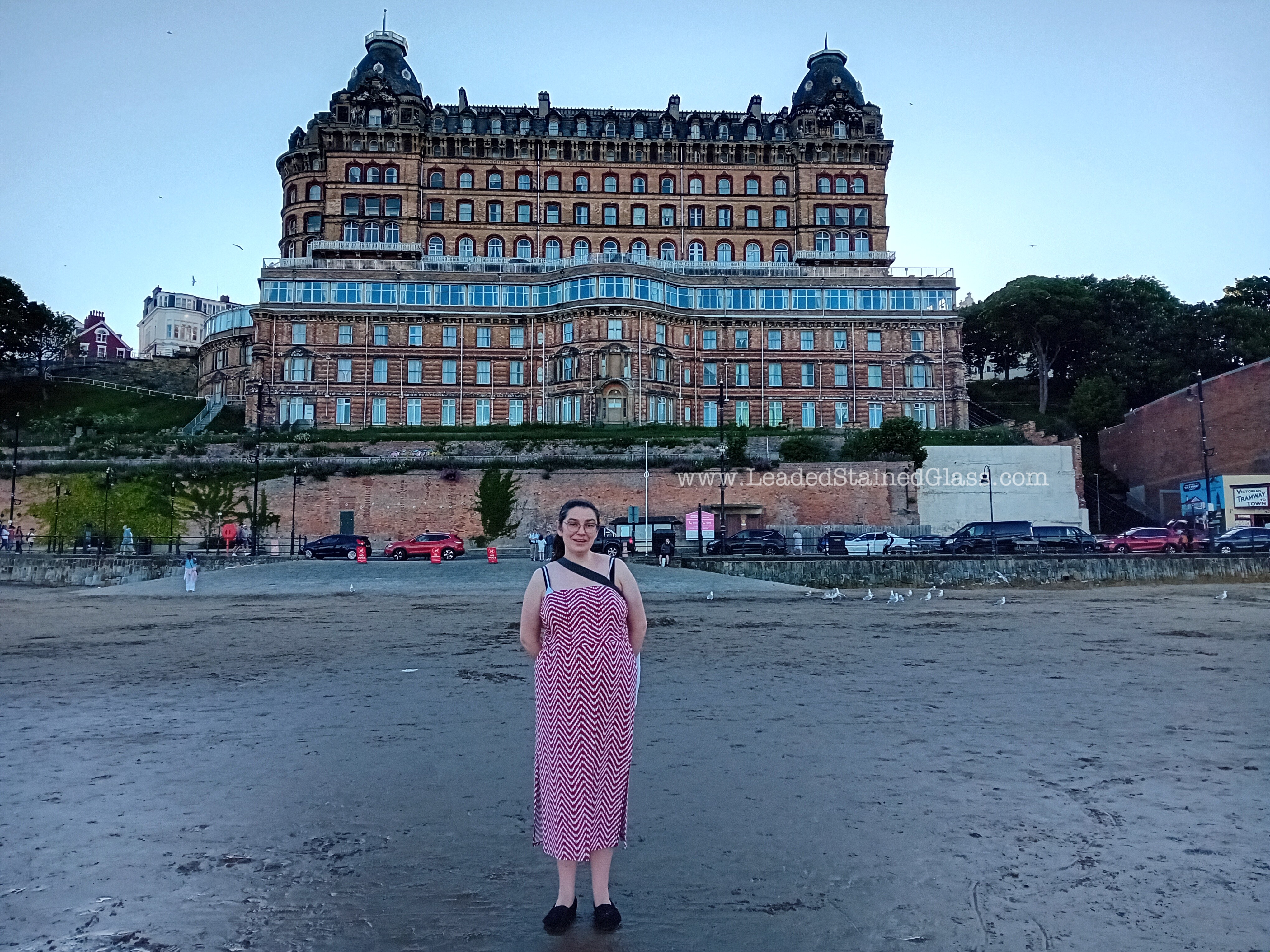
A little over three years ago, Richard and I went on a trip around the UK delivering and buying window glass. I wrote about this in a previous guest post for this blog, A librarian on a glass trip. While that trip was a holiday, it was very much a working holiday, with many stops collecting treasure. More often, business trips that I join Richard on are rather more holiday, just with some occasional glass related stops. This late May bank holiday weekend, and school half term, has been one of these holidays, with enough glass related anecdotes that we though another blog post was in order.
Holiday destination
The destination for this holiday was Scarborough in North Yorkshire – a long way away from our home in North West London. After seeing our children off to stay with grandparents (much appreciated!) we were on our way.
No holiday with Richard involves going directly to your destination… we stopped off in Headingly, a suburb of Leeds, to collect this piece…

…that he’d had his eye on for a while. Parts from this are for sale in the roundels, coloured panes and borders categories. The profits will contribute somewhat towards the diesel. It was the only purchase he had arranged before we set off, so could well have been the only contribution. Before he had this arranged he was a bit down, feeling the lack of a glass purchase or delivery – as was I too be honest – I do like the excitement of glass pick-ups.
The Grand Hotel
I am not one for organising holidays, and within reason don’t mind too much where I go – as long as I can have a break from work and cooking and so on, and a chance to read my book. Somewhere with history to explore is a plus. So I am happy for Richard to come up with ideas on where to stay, and make suggestions for me to agree to.
Scarborough was his idea, and I was immediately hooked once he told me about a Britannia hotel he’d found on a discount website, The Grand Hotel. The hotel we stayed at in Liverpool on our trip in 2023, the Adelphi, is a Britannia hotel. These are not luxury hotels anymore, but they are hotels that used to be grand in years gone by, and therefore have interesting history and architecture to explore.

Despite not specifically paying for a sea-view, we were lucky enough to be allocated a terrace room, with a brilliant view of the beach, and soundscape of waves or seagulls (depending on the time of day). Richard got rather obsessed with this regular visitor…

But on a more glass related topic, we did spend quite a bit of time pondering how often the seaside windows get cleaned, and considering the challenges of cleaning large numbers of high-up windows in an environment popular with sea birds!
We explored the hotel, which has 12 floors (for the 12 months of the year – one of many interesting figures learnt reading the history page of the Britannia website), on the lookout for interesting glass. We were not disappointed, as we discovered this window, containing figure-rolled glass, viewed from multiple floors overlooking the lobby. How many people would spot the value and history…?

We got a better view the more staircases we climbed, it was only on looking at the photos, with a proper close-up view, that Richard realised most of the panes were not hammered, but something else entirely. The “star” panes are also a rare find and he doesn’t know what they are called either.

In the hotel dining room, where we spent significant time due to the deal for our two day stay including breakfast and a buffet dinner, I noticed these leaded light dividers all around the room. Richard was initially dismissive when I pointed them out as he is used to seeing cheap modern versions of this kind of thing in pubs. But he took a closer look and decided they were well made. Being around so much nice intricate glass he does sometimes forget to notice functional pieces like this.

Glass in Scarborough
The Grand Hotel wasn’t the only reason to visit Scarborough. After a trip to Scarborough Castle (which is a ruin, and therefore has no windows with glass in), we went exploring round the town (aka walked for a long time to try and find Richard’s interpretation of a good pub garden – this trip took place in a heatwave weekend. Concerning, though pleasant for a seaside visit).

During our walk around town, we indulged in a favourite passtime: spotting interesting old window glass (and content for this blog post).
First up was this hidden treasure at the top side of a row of shops next to the hotel…

Not that rare still, but it’s always nice to see an original shopfront featuring leaded lights…

We also spotted one remaining window with leaded lights in a block of flats. Not the best of photos due to the shadows, but worth noting as an indication of how rare it is to see original window glass, and in Crittall frames, in this kind of building these days:

Finally, on an evening walk along the beachfront after dinner, we found our way to the Scarborough Spa (the town has a history as a spa town, which people would visit for the medicinal waters). The spa building is now an events venue, with shopfronts below. We initially were disappointed to see fake leaded lights (a glass pane with sticky lead attached to one side of the glass)…

…but then saw that some originals are still there …

The return journey
Richard commented on the journey from Scarborough to our next destination that the drive felt very long. Then realised that this was because all the potential pick-ups he’d had in mind hadn’t materialised, so he didn’t have any thrill to aim for (other than the nice hotel where the bulk of this blog post was written of course).
He’d has his eye on two doors, each of which had three huge panes of hammered glass. He lost out on these though as someone else had got in first. But this all adds to the thrill of the antique glass trade – never knowing whether you’re going to get the glass you’ve seen for sale.
The following day, we did lots more driving, which Richard didn’t seem to complain about too much. Partly because of a good podcast we were listening too, but mainly – I think – due to the fact that each destination involved some glass to pick-up. The night before, in a Peterborough hotel, he’d managed to arrange a pick-up of this from Norwich…

And at the last moment he remembered someone in Southend-on-Sea had offered him some hammered glass. Among the set was this, which is possibly the largest frameless hammered he’s ever had in stock…

This post was my idea and Richard was very happy to take me up on the offer – he’s always saying that it’s been so long since he published a blog post. And yet while I’ve been writing this he’s been full of ideas, constantly chipping in saying ‘we could say this… and this…’ I have had to be quite firm in keeping the blog post as my own story!
Alice Cann is an academic librarian, who blogs at researcherlibrarian.wordpress.com. She is also Richard’s wife. She has previously written about the glass business in:


