Posted on Leave a comment

Shelf life

Leaded stained glass top bay white wooden framed windows on a storage shelf.

Some of my stock sells within days, others could take years before making their way to a new home. There are a wide range of preferences within the world of people interested in old window glass (including stained glass), but I find that the items that I put up for sale that sell the quickest are often the smallest. This can be spare parts for stained glass artists and leaded lights makers, top light windows that can be installed to let light into a room or used for decoration, and those which are “above door” size and round windows.

Pieces I acquired in earlier years eventually come to the attention of someone who is looking for them. Part of the value of my business is having a large range of glass for customers to explore online, so that they don’t need to choose only from what an individual happens to be selling on third party platforms like Facebook Marketplace or eBay.

Waiting patiently for its new home

I thought it might be of interest to highlight one of those long shelf life items that I’ve had for years, and (after a browse through the stock on my website) have settled on this set of four mostly purple leaded windows which I rescued from the stairwell of a house in Chingford, June 2021…

Four leaded stained glass windows in white wooden frames
A1284. Four purple leaded stained glass windows

It’s clear to me that the reason this set hasn’t sold yet is because it’s large, and a set of four that depends on the pattern connecting. As you can imagine the cost to ship internationally would be considerable. Talking of ships, this took just over one year to set sale…

galleon ship, bird, clouds and lighthouse scene in a five part leaded stained glass wooden window
A1645a. SOLD

Quickly off the (virtual) shelves

Stock that sells more quickly are often smaller windows that could be used for multiple purposes – as decoration on a wall or as an internal partition, as well as replacing external windows. An example of a window that’s sold quickly recently is this geometric pattern, with four leaded lights in a wooden frame. It sold, to a customer in the USA, within a week of my listing it on the website. It’s small, colourful and compact, and it is flexible in that it could be placed vertically or horizontally. I photograph glass in both orientations whenever this makes sense.

Another feature that’s great for shipping is that because the frame is divided into multiple parts, a board can rest on the surface with greater support, thus reducing the possibility of it touching the glass if under pressure.

A wooden window frame (glass not visible), partly packaged for shipping, on top of layers of polystyrene, with plywood taped on top.

Old glass in short supply

Other glass I stock, which I often don’t keep for too long, is replacement parts used by stained glass artists, leaded light makers and glaziers. This could be roundels, figure rolled panes and all sorts of other glass! If you’re trying to match glass when repairing a window with cracks, then finding the right replacement glass can be tricky when the glass stopped being made decades ago. Or if you’re a creative making a new window from scratch, then you might not want to use the same bland range of machine-made products from China, often referred to as “hobby glass”.

Sometimes I have quite a selection of a particular glass in stock (such as Small flemish); whereas other (rarer) glass that I put on the website usually sells immediately. An example of this is cut glass glory stars – at the time of writing I only have eight available. People often ask if I have more and if I’m feeling witty I might say, sorry I’ve checked down the back of the sofa, nothing there!

Pricing to sell and to make a profit

I can’t ignore the fact that, at times, it is glass that I have priced higher that can take longer to find a customer. Pieces such as these are beautiful art works which deserve to be valued highly, in addition to me needing to make a viable income. So I accept that they need to wait in my possession until the kind of person who wants to invest in stained glass art discovers them (while always thinking of ways to try and get the word out).

Portability and packagability

It makes sense, theoretically at least, that an item is more likely to sell quickly if it is available to the widest range of people. The difficulty with this, with the product I’m selling, is that it doesn’t always make sense to make glass available for delivery anywhere in the world. If a window is small and can be packaged efficiently and shipped safely, then I am happy to sell it to anyone, wherever they are – with a delivery charge on the listing or working out a price on an individual basis.

For larger pieces of glass, particularly those which are frameless, it often isn’t worth the risk of offering to ship, as packaging them safely would involve a custom made wooden crate with a pallet base. That type of packaging is often costlier than the value of the glass, if the customer only wants one piece. Most people aren’t willing to pay that unless buying in multiples. It makes more sense to wait for a customer who can come and collect, or (if within Great Britain) who wants to pay for me to make a personal delivery.

Chance Bros No. GL303 Spotlyte window glass pane.
A1753c. Spotlyte Chance Brothers window glass

Conclusion

I literally take the view…

… that it doesn’t matter how long pieces take to sell. That’s because I have the luxury of being able to change the view from my window if I get bored.

Five leaded stained glass windows in different patterns on the inside of a bay window sill.
A1770ab, A1768b, A1765d, A1768a

Posted on Leave a comment

Difficult decisions

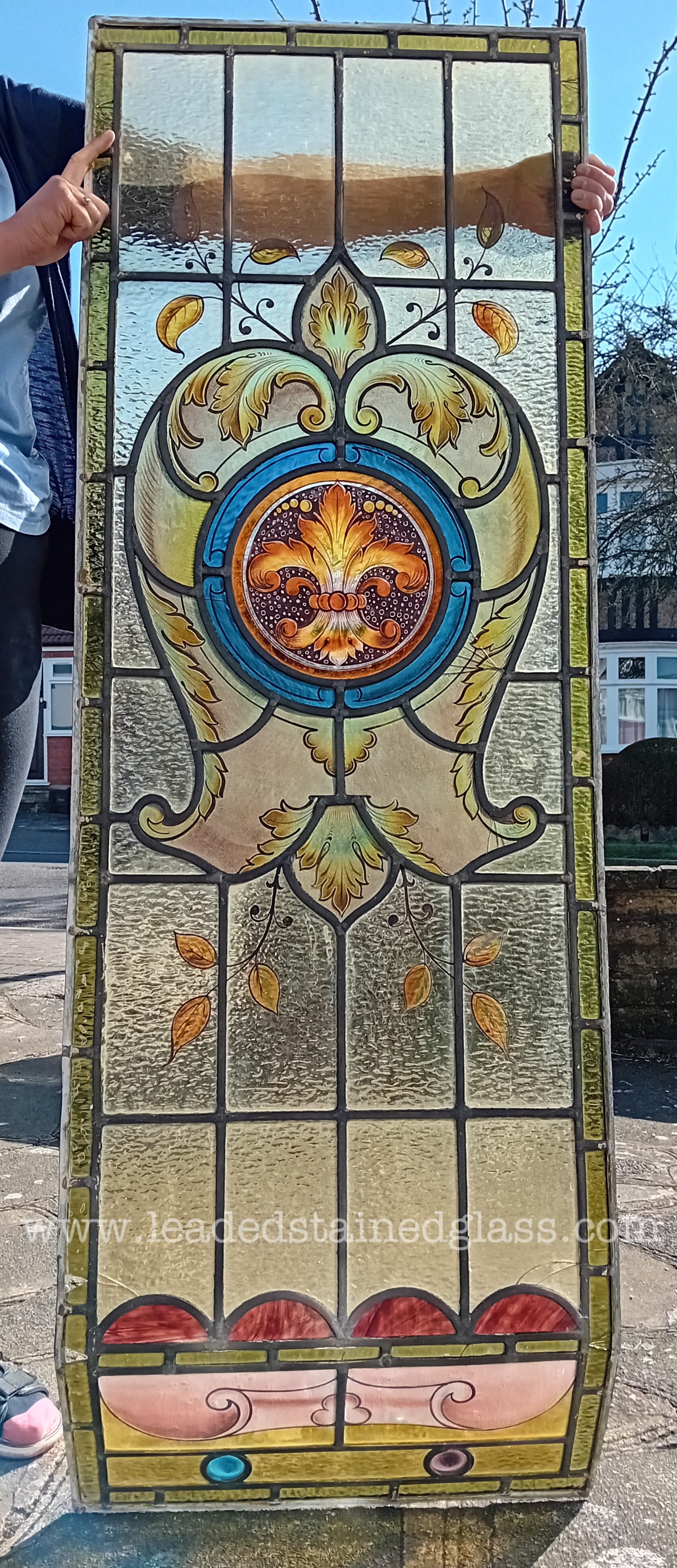
A hand painted leaded stained glass window panel with a kink at the bottom. It features a fleur-de-lis roundel in the middle.

I recently dismantled this stained glass leaded light. I know it looked fantastic but this post aims to explain why I would do such a thing.

In this post I will discuss:

What was wrong with it?

Several of the panes were cracked. As I’m a specialist salvage dealer, finding spare parts may not always be an issue, but it certainly is for any panes which are hand painted. This one had two cracked painted panes…

A hand painted leaded stained glass window panel with a fleur-de-lis roundel in the middle and three damaged panes.


The cost of commissioning a stained glass artist to make replacement parts, and fit, would likely be more than I paid for the entire leaded light. I know several talented stained glass artists who would do an amazing job but they still wouldn’t be able to produce an exact match, given that the paint and glass originally used are no longer available.

Something I can’t usually demonstrate when selling glass exclusively online is the robustness of the lead structure. The larger the leaded light, the more this should be a concern, just as much as the condition of the glass. In this example, however, it is easy to show that the leaded light had a significant kink along one of the horizontal lead lines…

Unfortunately just snapping the lower section off wouldn’t be a remedy, as the outer border would still need repair to complete the pattern.

The decisions

Sometimes I have to make the difficult decision whether to:

1) Sell in current condition

2) Have someone restore it

3) Dismantle to sell the parts

When I acquire a piece like this I may spend a few days pondering what to do. I could sell in its current “rustic” condition, a look which some people intentionally seek. But that could take a long time, given how large it is, and my London storage space is at a premium!

Restoration, transport and storage

If repairing, I would have to lug it to the restorer and back, after that I may still have to store long-term, and the shipping costs associated with a piece this size will make it harder to sell whatever condition it’s in. Now that I have years of experience, it’s very unlikely I will invest in a repair unless I’ve sold something similar for a worthwhile profit. Even if I want it restored, finding the right person with availability is another time consuming factor.

Ease of taking apart

Part of my decision to dismantle will be informed by how easy I think the process would be. My assessment is made by feeling the lead structure. From experience I can tell if a leaded light has been poorly constructed, even if it contains amazing glass. It could be that it was made with inferior cement or the cement has dried out so much that the bond between lead and glass is weak, or non existent.

If I conclude that the leaded light is more valuable in parts, I still have to consider how much money I will lose if I damage X number of parts, even with my experience of dismantling. In this example, I bought the leaded light with the full intention that I would dismantle, knowing the risks and likely profit margin. Therefore I bid for it accordingly.

Time

Probably the most important consideration is how much of my time will the dismantling process take? The more complex the lead pattern, the more time it will take, so is the glass worth it? Also, the time commitment to clear up the mess is not something to be underestimated…

A partly deconstructed leaded stained glass window lying on a table surrounded by all its cement debris and separated panes.

The parts

Another time commitment to factor in will be photographing the fragments. With a piece like this I know all the parts can be utilised. Obviously the centre piece was the fleur-de-lis roundel…

A fleur-de-lis hand painted leaded stained glass window roundel. It has a blue border with scroll-like ended curved lines.

… no doubt someone will use it as a new centre piece. Not only does the fragment contain a detailed heraldic pattern but the blue hand painted border is just as impressive, in my opinion anyway. The most alluring aspect, though, will be the convenient shipping price for this bold, but now relatively small, fragment.

Some of the floral parts could still be used to form part of a joining symmetrical pattern…

…or the entire set could be reused within some sort of collage?

Old handspun roundels sell like hot cakes! I predict this pair will have sold within 7 days of listing.

One blue and one purple hand spun window roundel.

These scrolls could work in all sorts of ways.

Hand painted scrolls on two stained glass window panes.

There’s certainly enough border glass here for a new small window – why buy modern “hobby glass”, probably made in China, when there’s so much interesting old glass lying around Britain?

Green border sized stained glass window panes.

Who uses the glass?

I have a varied customer base. While many people buy whole windows from me, I have an increasing following of people who work with old glass in a variety of ways. I suspect the people buying the above parts will be “arty” people. The parts will be used in projects for new leaded lights rather than replacements. Therefore the pattern can be made to fit around the size of these old parts. Many of my customers are abroad so this is an ideal opportunity for people to buy unique pieces.

I also sell to people doing repairs who need an exact match. They could be glaziers or confident “DIYers”. The above parts wouldn’t be aimed at that market group. I do dismantle leaded lights which don’t contain any hand painted glass. I might refer to this as “architectural window glass”. This is an example of one I dismantled because it had so many “decent sized” small flemish background panes, as well as interesting borders…

My post small flemish big suprise, documents another set of large leaded lights which I deconstructed.

Conclusions

If you’ve got this far and are still fuming that I caused such carnage, I must say that I did list the hand painted leaded light for one week beforehand in my windows for restoration category. And on Instagram I gave notice that it had only 24 hours to live, but no one paid the ransom!

It is a hard decision to make but I always know that nothing will go to waste!

I will eventually take several buckets of lead to a scrap metal dealer – beer money!

At the time of publishing this blog post, all the above glass was listed for sale on my website in the following categories: