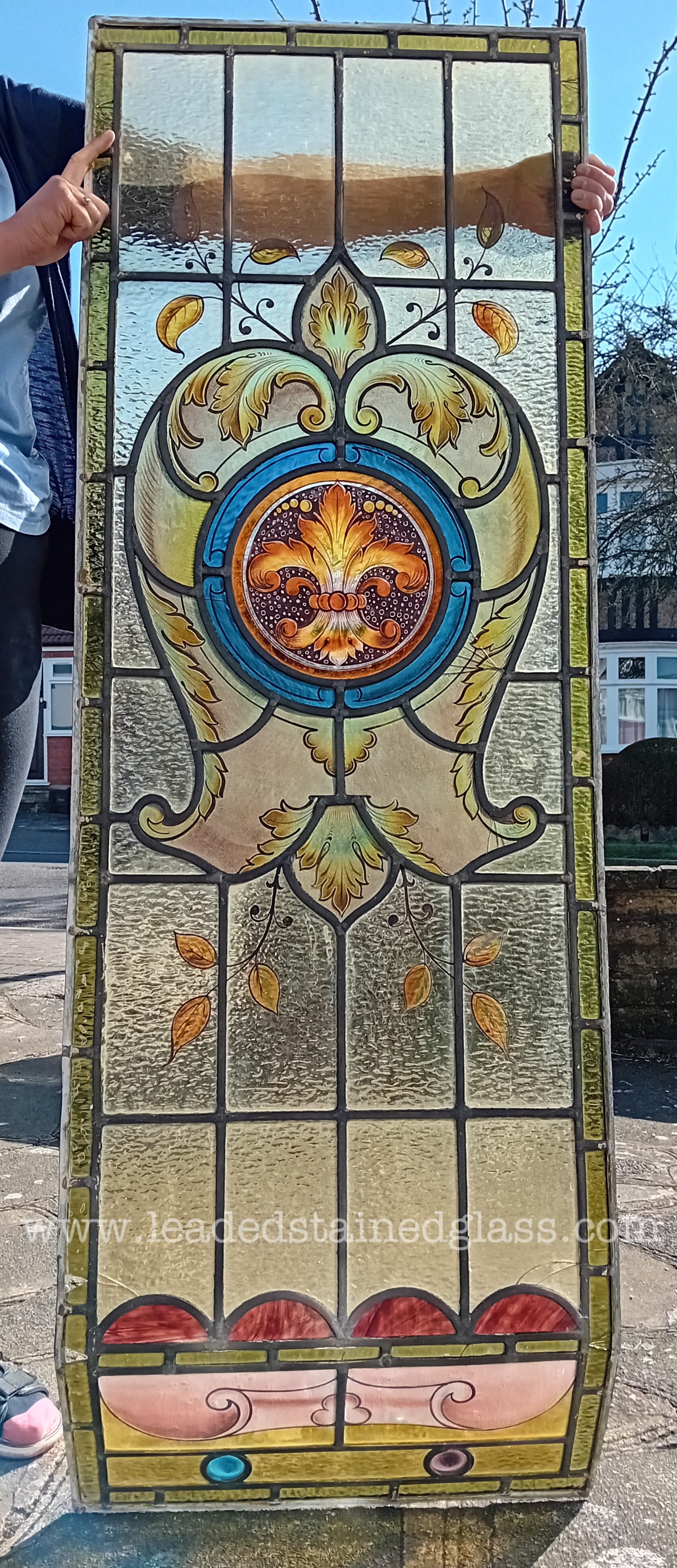
I recently dismantled this stained glass leaded light. I know it looked fantastic but this post aims to explain why I would do such a thing.

In this post I will discuss:
What was wrong with it?
Several of the panes were cracked. As I’m a specialist salvage dealer, finding spare parts may not always be an issue, but it certainly is for any panes which are hand painted. This one had two cracked painted panes…

The cost of commissioning a stained glass artist to make replacement parts, and fit, would likely be more than I paid for the entire leaded light. I know several talented stained glass artists who would do an amazing job but they still wouldn’t be able to produce an exact match, given that the paint and glass originally used are no longer available.
Something I can’t usually demonstrate when selling glass exclusively online is the robustness of the lead structure. The larger the leaded light, the more this should be a concern, just as much as the condition of the glass. In this example, however, it is easy to show that the leaded light had a significant kink along one of the horizontal lead lines…

Unfortunately just snapping the lower section off wouldn’t be a remedy, as the outer border would still need repair to complete the pattern.
The decisions
Sometimes I have to make the difficult decision whether to:
1) Sell in current condition
2) Have someone restore it
3) Dismantle to sell the parts
When I acquire a piece like this I may spend a few days pondering what to do. I could sell in its current “rustic” condition, a look which some people intentionally seek. But that could take a long time, given how large it is, and my London storage space is at a premium!
Restoration, transport and storage
If repairing, I would have to lug it to the restorer and back, after that I may still have to store long-term, and the shipping costs associated with a piece this size will make it harder to sell whatever condition it’s in. Now that I have years of experience, it’s very unlikely I will invest in a repair unless I’ve sold something similar for a worthwhile profit. Even if I want it restored, finding the right person with availability is another time consuming factor.
Ease of taking apart
Part of my decision to dismantle will be informed by how easy I think the process would be. My assessment is made by feeling the lead structure. From experience I can tell if a leaded light has been poorly constructed, even if it contains amazing glass. It could be that it was made with inferior cement or the cement has dried out so much that the bond between lead and glass is weak, or non existent.
If I conclude that the leaded light is more valuable in parts, I still have to consider how much money I will lose if I damage X number of parts, even with my experience of dismantling. In this example, I bought the leaded light with the full intention that I would dismantle, knowing the risks and likely profit margin. Therefore I bid for it accordingly.
Time
Probably the most important consideration is how much of my time will the dismantling process take? The more complex the lead pattern, the more time it will take, so is the glass worth it? Also, the time commitment to clear up the mess is not something to be underestimated…

The parts
Another time commitment to factor in will be photographing the fragments. With a piece like this I know all the parts can be utilised. Obviously the centre piece was the fleur-de-lis roundel…

… no doubt someone will use it as a new centre piece. Not only does the fragment contain a detailed heraldic pattern but the blue hand painted border is just as impressive, in my opinion anyway. The most alluring aspect, though, will be the convenient shipping price for this bold, but now relatively small, fragment.
Some of the floral parts could still be used to form part of a joining symmetrical pattern…

…or the entire set could be reused within some sort of collage?

Old handspun roundels sell like hot cakes! I predict this pair will have sold within 7 days of listing.

These scrolls could work in all sorts of ways.

There’s certainly enough border glass here for a new small window – why buy modern “hobby glass”, probably made in China, when there’s so much interesting old glass lying around Britain?

Who uses the glass?
I have a varied customer base. While many people buy whole windows from me, I have an increasing following of people who work with old glass in a variety of ways. I suspect the people buying the above parts will be “arty” people. The parts will be used in projects for new leaded lights rather than replacements. Therefore the pattern can be made to fit around the size of these old parts. Many of my customers are abroad so this is an ideal opportunity for people to buy unique pieces.
I also sell to people doing repairs who need an exact match. They could be glaziers or confident “DIYers”. The above parts wouldn’t be aimed at that market group. I do dismantle leaded lights which don’t contain any hand painted glass. I might refer to this as “architectural window glass”. This is an example of one I dismantled because it had so many “decent sized” small flemish background panes, as well as interesting borders…


My post small flemish big suprise, documents another set of large leaded lights which I deconstructed.
Conclusions
If you’ve got this far and are still fuming that I caused such carnage, I must say that I did list the hand painted leaded light for one week beforehand in my windows for restoration category. And on Instagram I gave notice that it had only 24 hours to live, but no one paid the ransom!
It is a hard decision to make but I always know that nothing will go to waste!

I will eventually take several buckets of lead to a scrap metal dealer – beer money!
At the time of publishing this blog post, all the above glass was listed for sale on my website in the following categories:


